
Facilities
Department of Electrical and Electronic Engineering (EEE)
Department Facilities
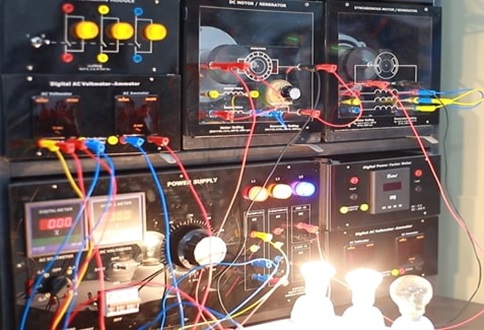
Power System Protection and Switchgear Laboratory
Power System Protection and Switchgear Laboratory is one of the most developed labs in the Electrical and Electronic Engineering Department. It is equipped with many advanced apparatus and devices to make all of the important tests on power systems starting from generation units with control panel. Also, it has protecting equipment, transmission lines and power factor correction panel. This laboratory is designed to directly apply theory learned in lectures to devices that will be studied in the laboratory. Power system protection is concerned with protecting electrical power systems from faults within the network by isolating the faulted components remaining the electrical network operation. Moreover, by properly protecting the system components from overloading, overvoltage, underfrequency the probability of fires and other catastrophic system failures can be minimized.
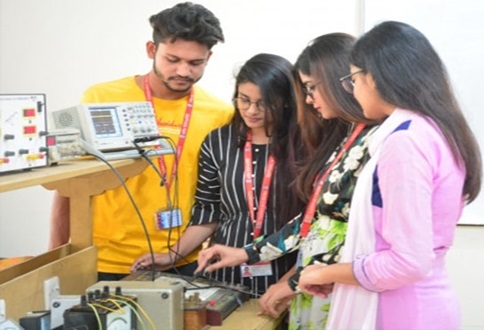
Electrical Circuits Laboratory
The Electrical and Electronic Engineering (EEE) Laboratory provides a dynamic environment where students gain practical knowledge alongside theoretical learning. It is equipped with modern instruments such as oscilloscopes, multimeters, power supplies,wattmeter to perform experiments in circuits.
Through hands-on sessions, students develop essential skills in circuit design, testing, measurement, and troubleshooting. The lab encourages innovation, critical thinking, and teamwork and also supporting project work
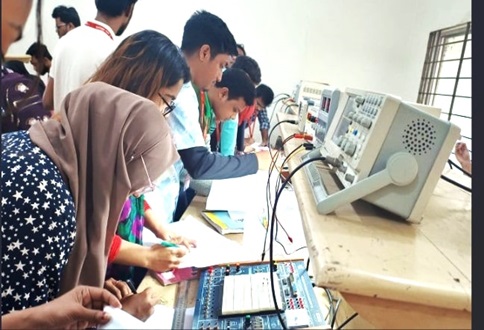
Electronics Laboratory
The Electronics Laboratory provides a well-equipped and interactive environment for students to develop practical skills in electronic systems. It supports experiments in both analog and digital electronics using modern equipment such as oscilloscopes, function generators, multimeters, and regulated power supplies.Students gain hands-on experience in designing, assembling, and analyzing circuits using components like diodes, transistors, and integrated circuits.
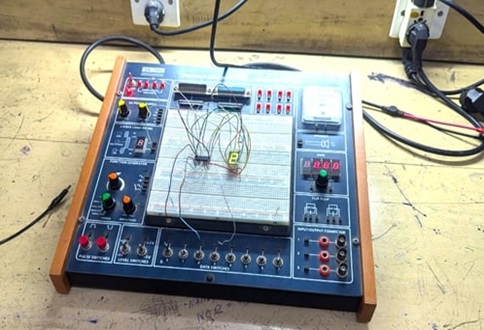
Digital Electronics Laboratory
Digital Electronics Laboratory is important in Electrical and Electronic Engineering (EEE) because it helps students learn the concepts and techniques of digital electronics through hands-on experiments. The main objective of this laboratory is to understand the basics of digital electronics, Boolean algebra and verify the basic gates like AND, OR, and NOT, and universal gates like NAND and NOR. Students will be able to design and analyze the combination of various logic circuits such as half adder, full adder, various types of flip-flops, counter and register. Also, students will realize the structure of various number systems and how they are applied in digital circuits design. Digital Electronics Laboratory is equipped with hardware and software facilities, such as oscilloscopes, function generators, digital multimeters, and experimental boxes. Students use these instruments to analyze input and output parameters, such as input and output waveforms, input and output current and voltage readings, and impedance or resistance.
Industrial and Power Electronics Laboratory
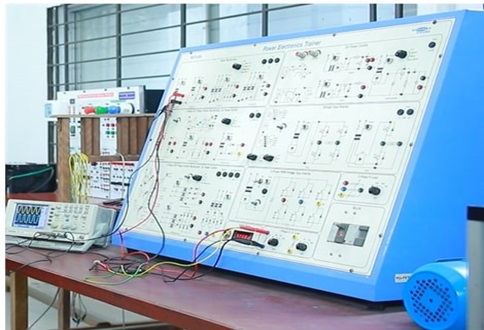
Industrial and Power Electronics Laboratory has been equipped with the fundamental and modern power electronics devices in order to expose, learn, and understand the applications of the existing power electronics. This laboratory introduces the student to measurement and analysis the important of operating characteristics of power electronic circuits, power semiconductor devices, direct current (DC) and alternating current (AC) drives for different load. This provides the basic knowledge in power electronic converters and operating characteristics of SCR, MOSFET. The Laboratory contains the Various Trainer Kits and Electric drives. The Trainer Kits include the MOSFET Characteristics, TRIAC Characteristics, SCR Characteristics, Single-phase and three-phase (controlled and uncontrolled) bridge rectifier, various inverters, various choppers, cycloconverters, various commutation circuits and different firing circuits
Communication Laboratory
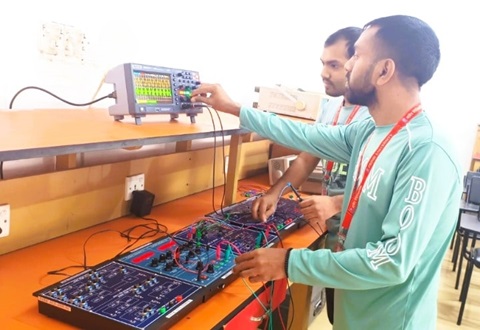
The Communication Laboratory in Electrical and Electronic Engineering (EEE) is crucial because it provides a practical platform for students to learn and apply theoretical concepts related to communication systems. By performing experiments on different modulation schemes (AM, FM, etc.) and transmission mediums, signal transmission, data transmission, and network protocols, students gain a deeper understanding of the underlying principles of communication systems. Students can directly interact with communication systems components like signal generators, spectrum analyzers, oscilloscopes, and modulation modules, allowing them to visualize and analyze signal characteristics in real-time. Overall, a well-equipped communication laboratory plays a vital role in providing EEE students with the practical knowledge and skills necessary to success in the field of communication engineering.
Energy Conversion Laboratory
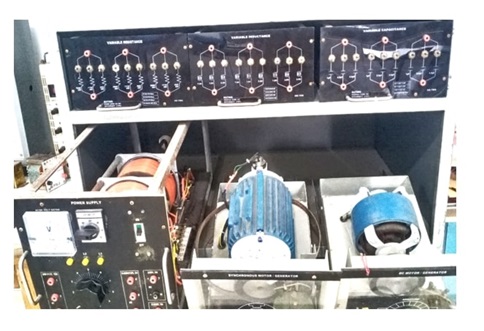
The Energy Conversion Laboratory or Electrical Machines Laboratory provides practical exposure to the student regarding the construction and operation of various electrical machines like DC Generators, DC Motors, Alternators, Synchronous motors, Induction Motors (single-phase and three-phase), Special Motors, and Transformers. Through hands-on lab experiments, the course introduces students to various laboratory equipment and teaches them to experimentally implement and use circuits involving a multitude of electrical machines. It also aims to understand the generation of DC voltages by using different type of generators and study their performance.
Measurment and Instrumentation Lab
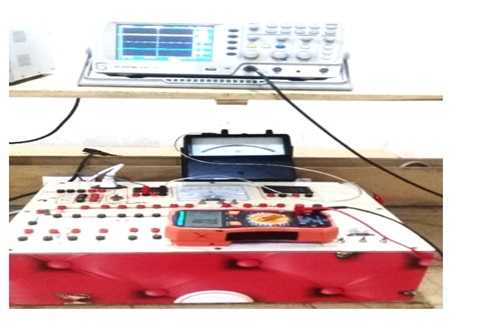
The Measurement and Instrumentation Laboratory is designed to provide students with practical knowledge of measurement principles, transducers, and modern instrumentation systems. It focuses on the accurate measurement of electrical and non-electrical quantities using various analog and digital instruments. The laboratory helps students understand the working principles of measurement systems and their real-world applications in industrial automation, process control, and monitoring systems. It enhances analytical skills, precision, and technical understanding required for engineering practice.
Microprocessor Lab
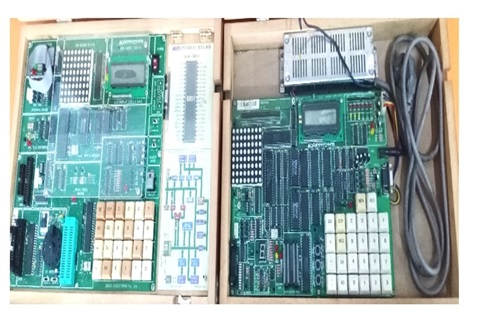
The Microprocessor Laboratory provides practical knowledge of microprocessor and microcontroller systems through hands-on experiments. It covers basic architecture, programming, and interfacing techniques.Students work with standard kits to interface input/output devices, memory, and peripherals, gaining an understanding of system operation and control.
Circuit Simulation Laboratory
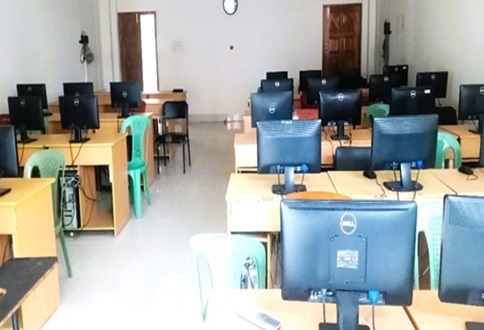
The objective of Circuit Simulation Laboratory in Electrical and Electronic Engineering is to teach students how to simulate and program electrical circuits. Students learn how to use software tools like MATLAB, PSPICE, and Multisim to simulate electrical systems. Also, students use simulation to verify the theoretical concepts of electrical engineering courses and gain practical experience with electrical circuits and learn how to use electrical measurement instruments. At the end of course, the students will be able to acquire skills of using PSPICE software for Electrical circuit studies. Also, students acquire skills of using computer packages like MATLAB coding and Simulink in Power Electronics and power system studies.
Physics Laboratory
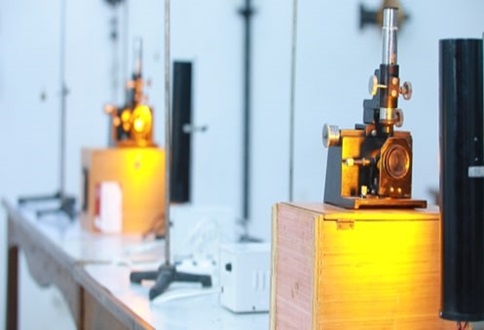
Physics Laboratory imparts the physical basics of engineering science by means of meaningful experimental setups that provide valid quantitative measurement results. The main focus of this laboratory is on kinematics, dynamics, vibration theory, fluid mechanics, thermodynamics, acoustics and optics. Laboratory experiment offers an opportunity to the students to familiarize themselves with various instruments, which they read in theory and this finds application in industry, engineering and everyday life. Physics experiments help the students in understanding the nature of science
Chemistry Laboratory
The Chemistry Laboratory provides students with practical knowledge of basic chemical concepts and experimental techniques. It is equipped with essential instruments and facilities to conduct experiments in areas such as solution preparation, titration, and material analysis.This lab helps students to connect theoretical learning with real-world applications by developing their skills in observation, measurement, and data analysis. It also emphasizes proper laboratory practices, safety rules, and responsible handling of chemicals.Through guided experiments and hands-on activities, students gain a better understanding of chemical processes that are important for engineering and technological studies. The laboratory plays an important role in building a strong scientific foundation for students.